
Busy is the enemy of progress
A good week isn't measured in standups attended or features shipped. It's measured in hard decisions made. Founders who confuse activity for momentum burn runway without ever finding out what's true.
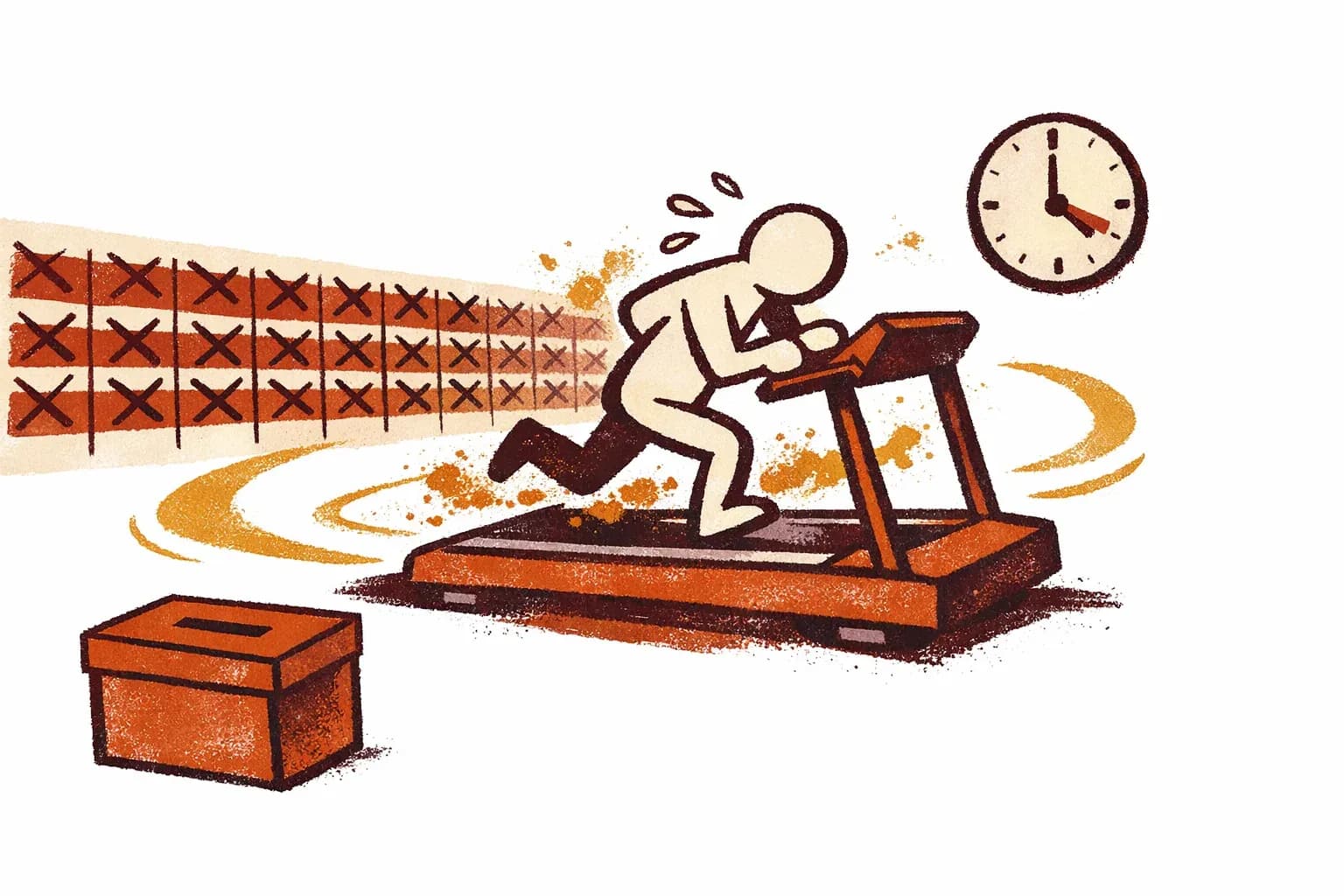
Every stalled startup I've walked into has had the same first hour. The founder shows me the sprint board. Tickets moved, features shipped, retros held. The team is busy. Everyone has work on. And then, somewhere around minute fifty, the founder says the uncomfortable thing: 'I don't know what we've actually decided in the last two months.'
Activity and progress feel identical from the inside. From the outside — and from the bank account — they're not. A team can look productive for a very long time while the company stops moving.
The decision count is the metric
When I'm trying to diagnose whether a team is actually progressing or just busy, I don't look at velocity charts or OKR scorecards. I look at one number: how many hard decisions did the founder make last week?
A hard decision is one where the trade-off was uncomfortable and the founder had to pick. Not 'which feature do we ship next' (usually a priority call, not a hard decision). Something like: 'we kill this customer segment', 'we fire this vendor', 'we double the price', 'we stop building X and start selling Y'. Calls that cost something.
A good week has three of those. A great week has one that nobody agreed with at the time but looked right a month later. A bad week has none — the team was busy, the standups ran, the product shipped, but nothing irreversible happened.
Why shipping looks like progress when it isn't
Engineering teams know how to execute. Tickets in, tickets out. The feedback loop is tight and satisfying. Standups surface blockers, retros improve throughput, velocity stabilises. It feels like the company is working.
What the velocity chart can't show you is whether the features you shipped changed anything for anyone. You can ship a clean, high-velocity sprint into a void for six months. The team will still feel busy. The founder will still feel productive. The runway won't care.
- If your sprint board looks healthy but your pipeline is flat — you're busy, not progressing
- If your team can name three decisions they made last week — you're progressing
- If every week looks like the last — you're on a treadmill
The Monday email test
The simplest diagnostic I know is the Monday email test. On a Monday morning, draft an email to your investors. One paragraph. What changed in the business last week? Not what you built. What CHANGED.
If the email writes itself in two minutes, you had a good week. If you struggle for fifteen minutes and end up listing features shipped, you were busy. If you can't write the email at all without it sounding like a corporate update — your team is in activity-theatre, not progress.
I'm not saying shut the engineering team down. I'm saying: every Monday, ask whether the last seven days generated a decision or just a deliverable. If it's been four Mondays without a decision, that's the signal. Stop, call the week, and change the shape of how the team works until decisions start showing up again.
Runway is a finite set of weeks. Each week is either a decision or a deliverable. Deliverables without decisions are how companies run out of money while their JIRA boards look healthy.
Found this useful?
Thirty minutes. Free. No pitch deck.
If the diagnosis is clear without me, you go do it. If not, we talk about the sprint. Either way, the first call takes 30 minutes and costs nothing.
Book the callKeep reading
All posts
The week you should have stopped building
Pre-Series-A companies usually have either a distribution problem or a product problem. Rarely both. The one you don't have is the one you keep working on.

Distraction has a CRM — it's called LinkedIn
Graham was right that competition doesn't kill startups — distraction does. What he didn't say: distraction in 2026 has an interface, a notification schedule, and a search function. It's called LinkedIn.

The co-founder state-of-the-union
The number-one thing that kills startups in the first two years isn't a bad product or a slow market. It's co-founders falling out. Most of them didn't have a language or a forum for the conversation that would have saved it.