
Delegate judgement, not work — the founder-to-CEO trap
The thing that got you from zero to eight people quietly stops working around person fifteen. Chesky's Founder Mode is right that you shouldn't detach. It's also half the answer.
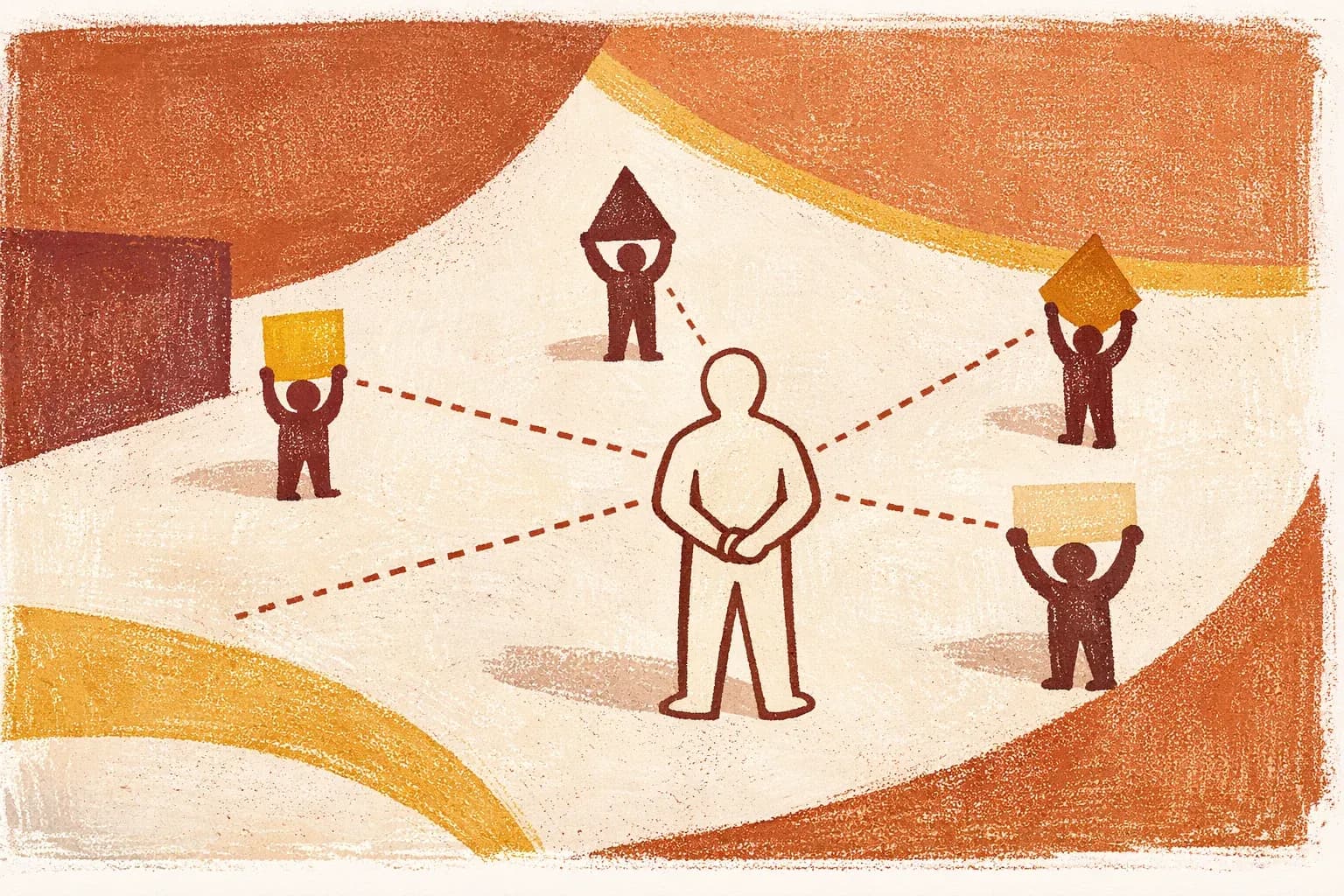
Somewhere between hire eight and fifteen, the thing that got you to product-market fit silently stops working. Your personal throughput stops being the company's bottleneck and starts being its ceiling. Decisions that used to take thirty minutes over a Slack DM now take three days because they need input from four people you hired. You notice it in the drift between demos.
The standard advice is 'delegate'. The standard advice is wrong, at this stage. Brian Chesky wrote Founder Mode in 2024 pushing back on it, and he was directionally right. But Founder Mode as most people read it — stay-in-all-details-forever — is also wrong, because it doesn't scale past you.
The frame that actually works
Delegate judgement, not work. Stay in the loop on everything. Hand the verdict on specific narrow surfaces to specific people — with the explicit authority to overrule you when you're wrong inside those surfaces.
Pricing is a surface. Customer segmentation is a surface. The hiring bar for the engineering team is a surface. You can't meaningfully delegate 'growth' or 'product' — those are too broad, too entangled with company strategy, and no one below founder has enough context to make the final call. But you CAN delegate 'the decision about which three customer accounts we prioritise this quarter'. That's a surface.
Why founders get this wrong
The founders who over-delegate hand out broad ownership ('You own growth now') and then second-guess every decision. The people they hired churn out in eight months, demoralised, and the founder concludes delegation doesn't work. It does — they delegated the wrong unit.
The founders who under-delegate refuse to let anyone decide anything without them in the room. That works when the company is eight people. It doesn't when it's fifteen — you become the bottleneck on fifty decisions a week, and the quality of every decision drops because you don't have the context on any of them.
The narrow-surface test
Before you delegate a decision, ask three questions: Is the surface narrow enough that one person can hold the full context? Is the person in front of you going to be living with the consequence for at least six months? Have you told them explicitly that they can overrule you, and if they overrule you, do you actually respect it?
If any of those is no, don't delegate the decision yet. Delegate the input to the decision and keep the verdict. That's the half-step that doesn't get written about enough.
Stay in the loop on everything. Delegate the verdict on narrow things. The difference between a founder who scales and one who burns out is precision about which verdicts.
Found this useful?
Thirty minutes. Free. No pitch deck.
If the diagnosis is clear without me, you go do it. If not, we talk about the sprint. Either way, the first call takes 30 minutes and costs nothing.
Book the callKeep reading
All posts
Busy is the enemy of progress
A good week isn't measured in standups attended or features shipped. It's measured in hard decisions made. Founders who confuse activity for momentum burn runway without ever finding out what's true.

The week you should have stopped building
Pre-Series-A companies usually have either a distribution problem or a product problem. Rarely both. The one you don't have is the one you keep working on.

Distraction has a CRM — it's called LinkedIn
Graham was right that competition doesn't kill startups — distraction does. What he didn't say: distraction in 2026 has an interface, a notification schedule, and a search function. It's called LinkedIn.