
Grit, stubbornness, and the three questions that tell them apart
Founder culture confuses perseverance with truth-avoidance and fail-fast with flinching. Both can be right; both can be wrong. Here's the diagnostic that separates the two inside the specific decision in front of you.
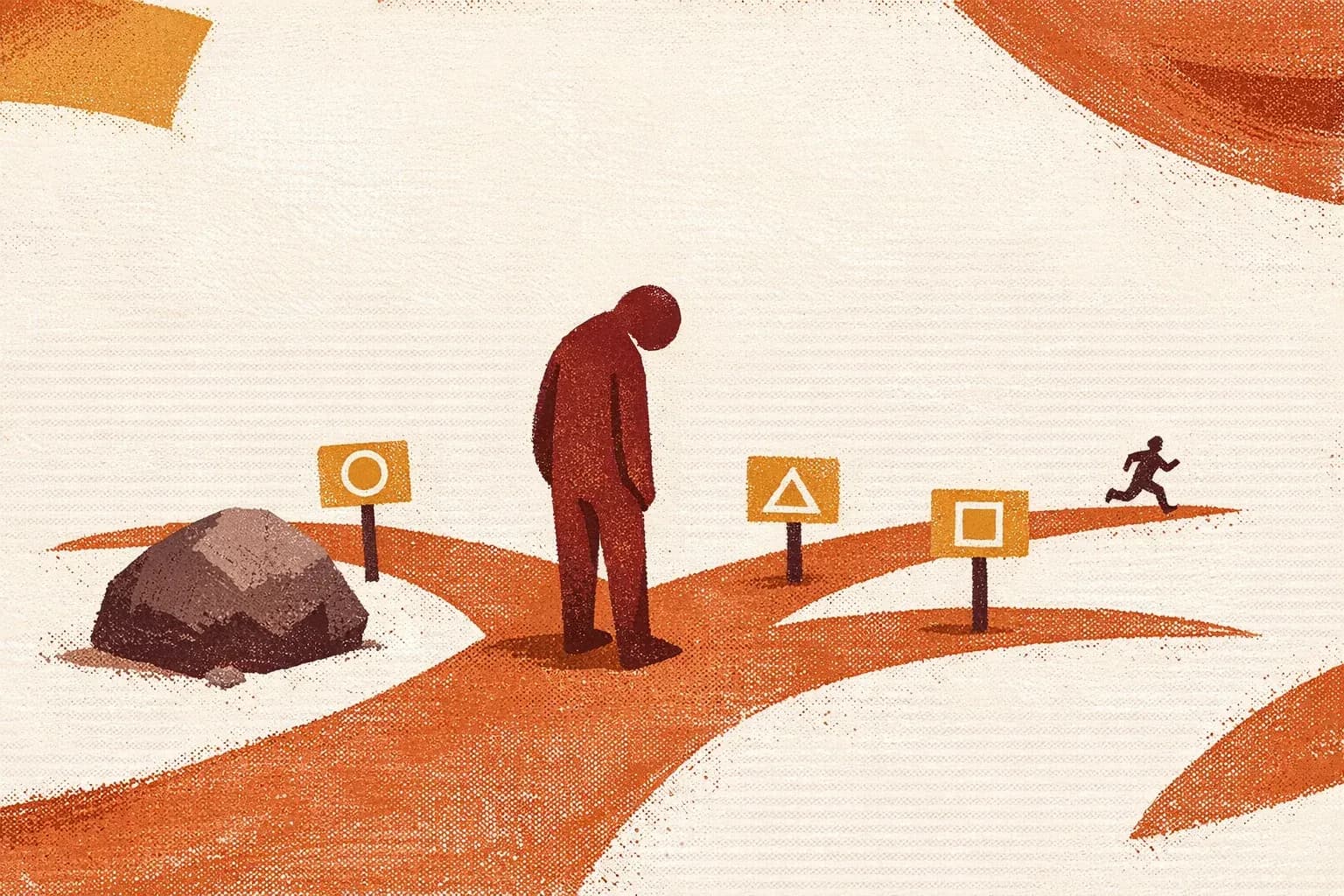
Grit and stubbornness look identical from the inside. They feel the same — the same determined jaw, the same willingness to skip sleep, the same conviction that the market doesn't understand you yet. What separates them is visible only from outside, or much later. The first produces outlier outcomes. The second produces funerals.
Annie Duke's line is the one that makes this actionable: the same psychological machinery that lets us power through hard things also lets us stick to things that aren't worthwhile. Grit is not a personality trait. It's a decision about a specific bet. And every quarter, a founder has to make it on a different bet — the product, the customer segment, the hire, the channel, the whole company.
The three questions
When I'm working with a founder who's wrestling with a keep-going-or-quit call, I ask three questions. Not because the answers are always clear, but because the act of answering them surfaces the difference between the two states.
1. Is the input changing?
Grit is continuing to push when each new round of pushing reveals something you didn't know. Stubbornness is running the same experiment louder, expecting a different result. If you're six months into a GTM motion and every month is producing roughly the same number of customers by roughly the same path, you're not learning — you're repeating. Repetition without new information is usually stubbornness wearing the costume of persistence.
2. Who benefits from you continuing?
If the honest answer is 'my team' or 'my customers' or 'my investors', continuing is likely grit. If the honest answer is 'my narrative' or 'my reputation' or 'my ego wants to not have been wrong about this', continuing is sunk-cost dressed as determination. The test is brutally simple: would a stranger with no history with this company, looking at only the numbers and the market, say keep going? If yes, keep going. If the answer is 'only because you started it' — that's stubbornness.
3. What would make you quit?
Grit has a floor. If you can't articulate in advance the condition under which you would stop, you're not being gritty — you're being anchored. Duke's framing: every commitment to keep going should come with a stated threshold for reassessment, pre-agreed with yourself and ideally with a co-founder or advisor. The founder who says 'I will never quit' is not gritty. She's trapped.
The pivot trap
One note on pivots. A pivot can be quiet quitting dressed up as perseverance. If you pivot the product, the ICP, and the thesis over eight months while telling yourself 'we're iterating', you may not be pivoting — you may be winding down in slow motion. The test: are the pivots narrowing toward something specific, or are they randomly walking away from each new failure?
Real pivots have a common thread — the insight that drove them shows up again in the new direction. Slow-motion windings-down don't; each pivot is a refusal to confront the previous one.
Grit is 'I will pay any price for this specific outcome.' Stubbornness is 'I will not change my mind regardless of input.' The former is rare and valuable. The latter is what company funerals are made of.
Found this useful?
Thirty minutes. Free. No pitch deck.
If the diagnosis is clear without me, you go do it. If not, we talk about the sprint. Either way, the first call takes 30 minutes and costs nothing.
Book the callKeep reading
All posts
Busy is the enemy of progress
A good week isn't measured in standups attended or features shipped. It's measured in hard decisions made. Founders who confuse activity for momentum burn runway without ever finding out what's true.
The week you should have stopped building
Pre-Series-A companies usually have either a distribution problem or a product problem. Rarely both. The one you don't have is the one you keep working on.

Distraction has a CRM — it's called LinkedIn
Graham was right that competition doesn't kill startups — distraction does. What he didn't say: distraction in 2026 has an interface, a notification schedule, and a search function. It's called LinkedIn.